Command center
The company’s command center. Projects, people, and KPIs in one view.

Now accepting pilot partners
Katana Business
One workspace for the work, the people, the customers, and the inventory — instead of eight tools that don’t talk.
By joining, you agree to our Privacy Policy.
Projects, HR, customers, workforce, inventory, and investors live in one place — so a hire, a job, a shipment, and a deadline aren’t trapped in separate apps.
Stack Cut
Pick your tools. See the cut against Katana Business — using real public list prices.
Stack Cut
0 selected
Public mid-tier list prices. Flat and location tools stay flat. Tiered plans scale with seats. Katana: $59 · $89 · $119/seat/mo.
What it is
Most growing companies don’t have an operations problem. They have a fragmentation problem. Project work lives in one tool. People live in another. Customers, inventory, field jobs, and investor outreach each get their own login, their own spreadsheet, their own version of the truth.
Katana Business is a connected operations OS for that company. It is not a bloated ERP that forces every department to adopt everything on day one, and it is not another single-purpose SaaS that you have to stitch together later. It is one workspace with a shared core — a Hub that shows what is happening — and modules you turn on as the business needs them.
The heart of the product is simple: the company should have one place where work, people, and assets are connected. When someone is hired, the rest of the system can see it. When a project moves, inventory and customers aren’t left behind. When a field job is scheduled, it isn’t a separate universe from the people doing it.
How it works
Teams sign in to a single workspace. Leadership lands on Hub — the command center — with a live view of projects, people, and the numbers that matter. From there, each part of the company works in its own module, on the same data.
Work is Kanban-first: boards, owners, dates, and status you can actually move. Around that sit the operating modules. They are separate on purpose, so a technician isn’t staring at a fundraising pipeline, but they are not siloed. Activity, notifications, and records cross the system so nothing important dies in a tab someone forgot to check.
You don’t have to rip out everything to start. Turn on what you need. Bring existing data in through Katana Switch when you’re ready to migrate instead of re-typing. The company keeps one source of truth as it grows.
What’s inside
The company’s command center. Projects, people, and KPIs in one view.
Plan and ship work with Kanban, timelines, owners, and reporting.
Track items, stock, and movement without a separate inventory app.
Accounts, success, and the relationship work that usually lives in a CRM.
Jobs, technicians, schedules, and timesheets for teams in the field.
Hire, manage, and give people a home for “what needs me today.”
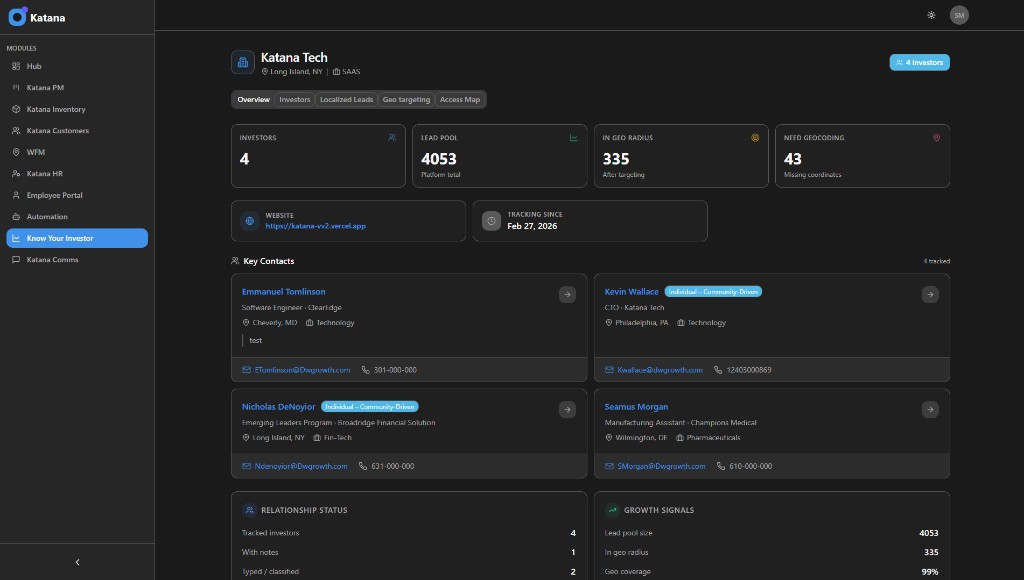
Track investors, outreach, and the relationship map around the company.
Also in the platform: comms, finance, e-sign, careers, automation, and agent office.
In the product
The company’s command center
Leadership lands here: a live view of projects, people, and the numbers that matter. One shared core — then modules you turn on as the business needs them.
Kanban-first work
Plan and ship work with Kanban, timelines, owners, and reporting. Boards, dates, and status you can actually move — on the same data as people, inventory, and customers.
Items, stock, movement
Track items, stock, and movement without a separate inventory app. When a project moves, inventory isn’t left behind in another login.
Accounts and success
Accounts, success, and the relationship work that usually lives in a CRM — connected to the jobs, inventory, and people doing the work.
Jobs in the field
Jobs, technicians, schedules, and timesheets. A field job isn’t a separate universe from the people doing it.
Hire, manage, what needs me
Hire, manage, and give people a home for “what needs me today.” When someone is hired, the rest of the system can see it.
Outreach and the map
Track investors, outreach, and the relationship map around the company — in the same workspace, not a forgotten spreadsheet.
Turn on what you need. Keep one source of truth as the company grows.
Join the pilot